
From September, all of the clothes featured in Burberry’s runway shows will be available to buy immediately, instore and online, a significant departure from the conventional model in which clothes appear on catwalks four months before they go on sale.
The brand will also scale down from four catwalk shows a year to two. Christopher Bailey, the chief creative officer of Burberry, called it “the latest step in a creative process that will continue to evolve”..
The move will enable customers to shop directly from the catwalks, but threatens to undermine a system in which glossy fashion magazines, which typically work three months ahead, had the upper hand.
“It’s fashion rebooting to be in touch with reality,” says Sarah Mower, Vogue’s chief critic and the British Fashion Council’s ambassador for emerging talent. “Currently there’s instant access to shows but constant deferral. If you can’t buy it immediately, you forget about it.”
Damien Paul, the head of menswear at matchesfashion.com, said that for buyers in stores other than Burberry’s own, “it definitely feels like a much-needed shift to the existing system”.
He added: “Ultimately, it services the customers better. We certainly know that our customers are looking for access to the collections as soon as possible.”
Tom Ford also announced a change to his collections. The ex-Gucci designer will show his autumn/winter 2016 collection in September rather than February, as the conventional model dictates. “We spend an enormous amount of money and energy to stage an event that creates excitement too far in advance of when the collection is available to the consumer,” he said in a statement.
Mower said the new approach would circumnavigate copyists, and catwalk-like designs appearing in high street shops before the real thing was available to buy. “As it stands, there are four months to copywhat is on the runway,” she said. “This stops that, which is a positive thing.”
Along with Ford, Céline, the much-watched Parisian house, conducts a media blackout on images from its pre-fall collection until the clothes are in the stores, for what Mower calls a “see now, buy now” strategy.
The CFDA, the body that organises New York fashion week, has hired business consultants BCG to look at the problem of presenting collections four months in advance of them hitting the shops, and the possibility of switching seasons, Ford-style – spring/summer shown in February, autumn/winter in September – to make these shows more immediately “shoppable”, to use an industry term.
Diane von Furstenberg, the CFDA chairman and a designer, told WWD: “Something’s not right anymore because of social media, people are confused … Everyone seems to feel that the shows being consumer-driven is a very good idea.”
“It’s been the critics reporting, and the buyers responding to that,” added Mower. “Now the consumer is the critic.”
But while this new model makes sense for a global brand such as Burberry, with inhouse manufacturing and a pre-tax profit of £456m in 2015, smaller brands will be in a difficult position, said Mower, because they need that period of time to work on the production that turns the prototypes on the catwalk to the clothes in the shops.
If Burberry’s move signals a wider change in the industry, their place – and that of the next generation of designers – may be compromised
Vanity Fair’s Hollywood issue: four fashion questions
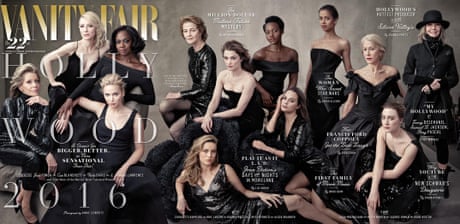
1. Is honesty the new Photoshop?
Two months ago, Leibovitz gave the Pirelli calendar a reality check, swapping its usual taut, dewy-skinned aesthetic for an earthier vision of womanhood with wrinkles and soft rolls of fat on show. Now, the photographer brings realness to the Hollywood issue. The cover argues that age is no barrier to sequin-clad glamour, while the portfolio inside is “raw, intimate, and honest”, according to Vanity Fair, and “dismissive of the shackles of airbrushing and Picasso’d Photoshop manipulations”. In practice, this means artfully messed-up hair, visible crow’s feet and irregularities in skintone against a backdrop of frayed-edged, sludge-coloured fabric that looks like an American-civil-war-era carte de visite. Importantly, though, everyone still looks hot.2. Are shoulders fashion’s most democratic body part?
Usually, when the fashion industry presents a new way to flash flesh – be that side butt or thigh gap or, recently, upper abs – it is met with a groan by all but the most confident and lithe. The industry’s recent fondness for bare shoulders, however, is truly democratic. According to Donna Karan, who has made a living from the cold-shoulder dress beloved of Hillary Clinton, shoulders are the last place most of us put on weight or get crinkly. This cover would confirm that – it’s clavicles for miles.3. Do older stars have more control over the way that they dress?
As far as Diane Keaton, 70, is concerned, the answer is yes. The actor’s signature Annie Hall style has morphed into something more Chim Chim Cher-ee in recent years; the outfit she wears here – military hat, cravat and overcoat, paired with cropped leggings and biker boots – is her own. That decision came about after a 45-minute conversation before the shoot, according to the stylist Jessica Diehl. “Sometimes, when you get somebody like that, who has taken so much time to hone her personal style, you’re almost an idiot to try and improve upon that in five and a half minutes,” she said. Going mufti may well have landed Keaton the less-than-coveted over-the-gatefold slot, but it says a lot about her confidence in her look. Elsewhere, Jane Fonda rebels a little in a sequinned jumpsuit, while Charlotte Rampling has been allowed to wear tights.4. Will it ever be fashionable to smile? Compare this cover with Vanity Fair’s 1995 issue, which featured a raft of twenty- and thirtysomethings in boudoir silk (Sarah Jessica Parker in a bra; Uma Thurman in a lace negligee; Julianne Moore in a mink-coloured slip), and it seems that fashion has moved on somewhat from its obsession with nudity and youth. One thing that has not changed, however, is the demeanour: they all look haughty and aloof, aside from Keaton, whose cheerful bearing only adds to the impression that she has been Photoshopped in from one of Guy Ritchie’s Sherlock Holmes movies. Her angst-free expression confirms that the actor’s sartorial humblebrag has won this cover. Keaton (who recently started selling her own wine, designed to be served over ice, of which she said: “It’s not fancy – but then neither am I”) knows the value of sticking to her ballgown-free brand.
Top 10 winter lipstick shades
ABC Life Style, Feb-02, 2016
It's still pretty cold outside
and we're not ready to whip out the coral lipstick yet. Hand us a rich,
dark lipstick and let us be all moody and wintery about it, okay? Here's
our round-up of our ten favourite winter lipstick shades. Pair with a
slick of mascara and let your lips do the talking.
Tom Ford

Lipstick in Moroccan Rouge by Tom Ford, £38
Mac

Lipstick in Russian Red by Mac, £14
Hourglass

Opaque Rouge Liquid Lipstick in Empress by Hourglass, £23
Bobbi Brown

Rich Lip Color in Crimson by Bobbi Brown, £20
Charlotte Tilbury

Matte Revolution Lipstick in Glastonberry by Charlotte Tilbury, £23
Bourjois

Rouge Edition Velvet lipstick in Grand Cru, £8.99
Surratt Beauty

Lipslique in Au Courant by Surratt Beauty, £22
Illamasqua

Lipstick in Pristine by Illamasqua, £29.50
Revlon

ColorBurst Matte Balm in Fiery by Revlon, £7.99
Estee Lauder

Pure Color Envy Matte Lipstick in Desirous by Estee Lauder, £25



0 comments:
New comments are not allowed.